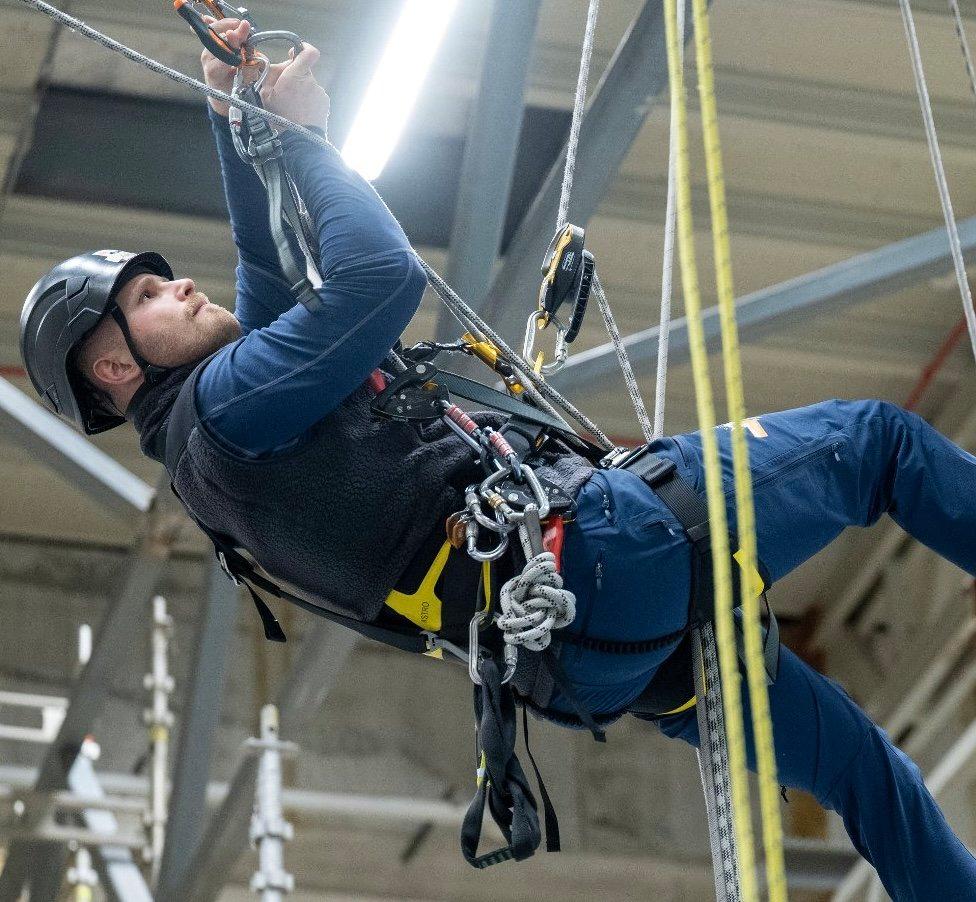
Rope Access is an advanced rope-based method that ensures safe access, securing, and execution of work at height. The method was originally developed for use in the oil and gas industry but is now widely applied across land-based industries as well. Rope Access enables technicians to perform tasks in locations that would otherwise be inaccessible, using ropes and specialised equipment. StS-ISONOR is a certified training provider in accordance with NS 9600 Rope Access.
About the Course
Rope Access is an advanced rope-based method that ensures safe access, securing, and execution of work at height. The method was originally developed for use in the oil and gas industry but is now widely applied across land-based industries as well. Rope Access enables technicians to perform tasks in locations that would otherwise be inaccessible, using ropes and specialised equipment. The method is recognised for its high level of safety and efficiency and is often used in situations where traditional access methods are impractical or unsafe.
StS-ISONOR is a certified training provider in accordance with NS 9600 Rope Access.
Participants learn how to secure themselves and others and how to perform work in a safe and efficient manner. The course also covers supervision and follow-up of personnel, which is essential for maintaining safety and efficiency within a Rope Access team. Training includes both theoretical and practical elements, providing participants with a comprehensive understanding of Rope Access techniques.
Rope Access is a method that requires a high degree of precision and skill. Operators must be well trained in the use of adjustment devices, ropes, carabiners, harnesses, and other equipment used to secure themselves and others.
The course allows participants to practise these skills in controlled environments, preparing them for real working conditions. In addition to technical skills, the course places strong emphasis on safety and risk management. Participants learn how to identify and assess risks and how to implement measures to minimise the likelihood of accidents and injuries.
Experienced and Friendly Instructors
You will be taught by experienced and friendly instructors approved in accordance with NS 9600. The examination itself is conducted by an examiner from the certification body SOFT Certification. All courses (Levels 1, 2, and 3) conclude with both a theoretical and a practical examination on the final course day.
Course Information
Duration
Level 1, Level 2 Module 1 and Level 3:
- 45 hours of training
- Theoretical and practical examination: 7.5 hours
Level 2 Module 2:
- 67.5 hours over 9 days
- Theoretical and practical examination: 7.5 hours
Target Group
Individuals who work at height, or who wish to work using Rope Access techniques.
Entry Requirements
General – All Levels:
- Good physical and mental health
- Qualifying work hours must be logged within a maximum of 5 years prior to course start. Qualifying hours are counted from the start date of the current competency level.
- Applicants must hold a valid medical certificate. The medical certificate must not be older than 3 years.
Rope Access Operator Level 1:
- Candidate must have turned 18 before admission
Rope Access Operator Level 2, Module 1:
- Candidate must have turned 20 before admission
- Minimum 500 logged hours as Level 1 operator, over at least 12 months
Rope Access Operator Level 2, Module 2:
- Candidate must be at least 20 years of age
Must document at least one of the following:
- Minimum 600 hours of rope work over at least 3 years
- Minimum 5 years' experience as an instructor on rock climbing courses in accordance with Norwegian Mountaineering Forum standards
- Certified UIAGM mountain guide
- Membership and experience in an alpine rescue group affiliated with NARG
Rope Access Operator Level 3:
- Candidate must have turned 22 before admission
- Minimum 700 logged hours as Level 2 operator over at least 12 months
- Candidates starting the supervisor trainee period must hold a valid Level 3 certificate
Certificate Validity
Upon passing the theoretical and practical examination, SOFT Certification issues a certificate. The certificate is valid for 3 years from the date of issue, and the certificate holder must complete a recertification course to maintain its validity. If the certificate has expired, the candidate may complete a new course at the same or next level (if other requirements are met) within 24 months of the expiry date.
Supervisors with an expired certificate who complete the full Level 3 course within 24 months do not need to complete a new assistant period. Within 60 months of expiry, candidates may start the Level 3 course and follow the standard qualification pathway to supervisor level.
Location
Sandbrekketoppen 30, 5224 Nesttun